

When someone in debt picks up the phone, the conversation decides what happens next. In September 2026 the FCA warned consumers about four red flags in debt advice. Every one of them happens in a conversation, which means every one of them can be heard on a recorded call.
This article sets out what the FCA said, what each red flag sounds like on a call, and how to check your advisers stay clear of them.
What the FCA warned about
On 22 September 2026 the FCA urged people seeking debt advice to watch out for red flags. Its concern is that some consumers are being steered towards fee-paying debt solutions that may not suit them. Sometimes that happens through high-pressure sales, sometimes through misleading information, and sometimes through firms that don't have the right permissions.
Free debt advice is available to everyone. That's why steering someone towards a paid solution, without first explaining the free options, is such a serious concern.
The FCA has already acted. It stopped one debt advice firm from taking on new customers after finding that staff had led customers towards answers that made them look eligible for a fee-paying IVA, rather than giving impartial advice.
The four red flags, and what they sound like
| Red flag | What it can sound like on a call | What a reviewer should check |
|---|---|---|
| Pressure to decide quickly | "If we don't get this signed today, I can't hold this for you." | Was the customer given time to think and to look at other options? |
| Coaching the customer's answers | "Let's put your food spend down a bit lower, that works better." | Are the income and spending figures the customer's own? |
| Not explaining free alternatives | No mention of free debt advice at any point. | Were fee-free options explained before any paid solution? |
| Unclear identity | The adviser gives a first name but no firm name. | Did the adviser say who they are and who they work for? |
The example lines are illustrations, not quotes from real calls. But anyone who has listened to sales calls in this market will recognise them.
Why this matters beyond debt advice
The red flags are written for debt advice, but the pattern applies to any firm selling to people under financial pressure: loans, credit broking, insurance and claims. Under the Consumer Duty, firms must deliver good outcomes for retail customers, and that includes avoiding harm they could have foreseen.
In July 2026 the FCA published a review of how firms monitor customer outcomes. One finding stands out for phone teams. Some firms used sales measures, such as conversion rates, as a stand-in for customer outcomes. A coached customer who signs up looks like a success on a sales report. It only shows up as a problem when someone listens to the call.

Book a 30-minute demo and we'll review a sample of your calls against these red flags.
Book a demoHow to check your calls for each red flag
- Write each red flag into your call standards. Turn "no pressure" into something a reviewer can hear: did the adviser give the customer time to think, and say so?
- Make sure the figures are the customer's own. Check that the income and spending agreed on the call match the form, and that the adviser didn't suggest changes.
- Check free options came first. If a paid solution was offered, listen for whether free debt advice was mentioned before it.
- Check the adviser named the firm. A first name alone isn't enough.
- Treat the serious ones as pass or fail. Some standards aren't worth points. A coached answer should fail the call, whatever else went well.
- Look at patterns, not single calls. One adviser who rushes customers is a coaching issue. A whole team doing it points to a process or incentive problem.
A customer who was coached into a solution can look like your best sale of the month.
Vulnerability changes the stakes
People seeking debt advice are more likely to be in vulnerable circumstances. The FCA's outcomes review praised firms that split their vulnerability data by driver, such as health, life events and financial resilience, instead of reporting one total. That way a firm can see whether, for example, customers who mention a bereavement are treated differently from everyone else.
The review also made clear that smaller firms don't need complex systems. Regular checks of calls, files and complaints can be enough, as long as the firm acts on what it finds and then checks that the fix worked.
How Converc helps
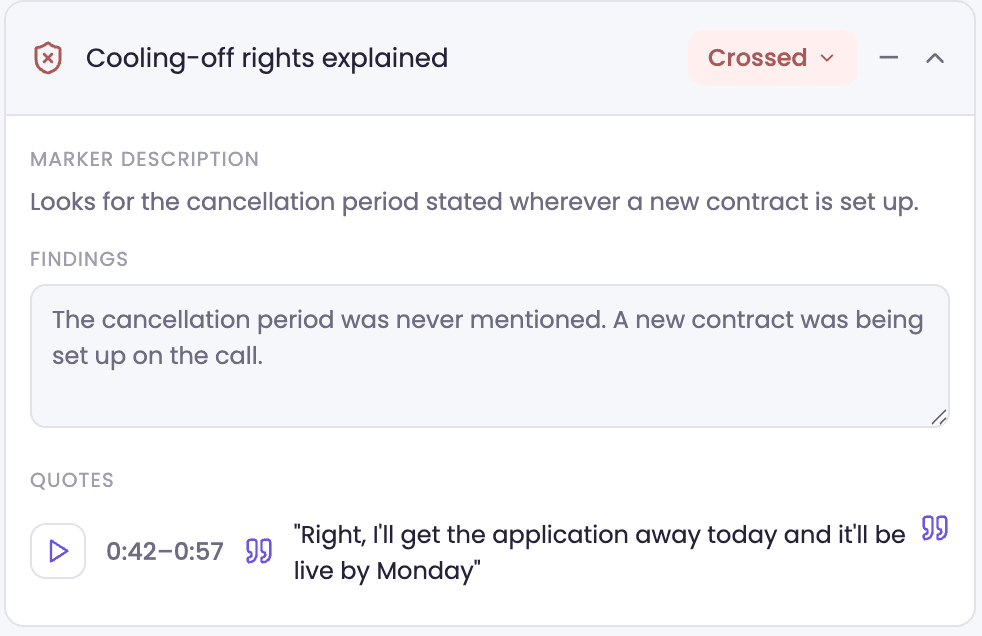
Converc reviews every call against your scorecard. You can make each red flag a marker, and make the serious ones red lines, so that one failure fails the call. Each judgement comes with a quote from the call as evidence, and your people make the final decision.
Monitor shows you the patterns: which advisers, which markers and which vulnerability drivers. Improve enrols advisers who fall short into training, and their next calls show whether it worked. That is the loop the FCA describes: find the problem, fix it, and prove the fix worked.
Sources
- FCA: Debt advice warning: spot the red flags — 22 September 2026
- FCA: Outcomes monitoring: good practice and areas for improvement — 27 July 2026
- FCA: Consumer Duty
This article is general information, not compliance advice. · Last checked 22 October 2026

Written by the team that builds Converc, drawing on work with compliance, QA and training leads across regulated UK firms.