

AI is no longer an experiment in financial services. In June 2026 the FCA's chief executive, Nikhil Rathi, said studies suggest more than 80% of firms are already adopting it. In October, the FCA's chief data, information and intelligence officer, Jessica Rusu, put the figure at 86%, citing a joint survey with the Bank of England.
For firms that review calls, the question is no longer whether to use AI. It's how to use it so that you, your board and the regulator can trust the results.
What the FCA said in October 2026
In her October speech, Jessica Rusu set out three things the FCA has seen from testing firms' use of AI this year. Each one applies directly to call review.
Put the consumer first. The FCA praised one firm whose chatbot used a live list of vulnerability signs to pass customers who might need extra support to a human adviser. It criticised firms that built AI tools without a clear need, shut out vulnerable customers by default, overstated what their tools could do, or launched automated customer journeys without enough testing.
Know who is accountable. Firms need clear ownership, risk-based controls, human oversight and triggers for escalating problems, with senior managers personally accountable for their AI systems. The FCA criticised firms that bolted governance on after the technology was already running, or didn't update their monitoring as their systems changed.
Plan for failure. Stress-test AI systems, keep fallback options, and understand what you depend on, including reliance on a single AI model.
Nikhil Rathi made the same point in June: accountability for regulated activities and outcomes must stay clear, with the right human oversight built in.
What the FCA has seen work in monitoring
The FCA's other recent reviews give practical examples.
In its July 2026 review of outcomes monitoring, one firm tested an AI tool that checks customer communications against the results of human testing. The results largely matched. The FCA said AI can support and add to human review, with the right guardrails. A smaller firm used meeting recording software to keep consistent records of client conversations, which made signs of vulnerability easier to spot, with people still making the judgements.
In its 2025 review of off-channel communications, some firms used language tools and AI to cut false alerts. But the same review found one transcription service that was largely inaccurate, and reminded firms they can't hand their responsibility to a supplier.

Seven questions to ask any AI call review supplier
| Question | Why it matters |
|---|---|
| Does every judgement come with evidence from the call? | A person must be able to check why the AI decided what it did. |
| Who makes the final decision? | Accountability stays with your firm, not the software. |
| If a person changes a result, is the AI's original answer kept? | You need a record of both, to explain any score later. |
| Can you tell which version of the AI's instructions was used on each call? | Systems change over time, and the FCA expects monitoring to keep up. |
| What happens when the AI can't reach a verdict? | Failures should go to a person, not disappear. |
| How accurate are the transcripts, and can we check them? | A wrong transcript means a wrong judgement. |
| How does it spot signs of vulnerability? | The FCA's first test is whether consumers come first. |
AI should make your reviewers faster, not take their judgement away.
What this means for your firm
- Name a senior owner for AI in quality assurance.
- Test AI results against your own reviewers before relying on them, and keep testing.
- Keep people making the final decisions, especially on serious failures.
- Check your monitoring whenever the AI changes, not just when it's first set up.
- Plan for the day it fails. Know what happens to calls the AI can't judge.
How Converc's AI is built
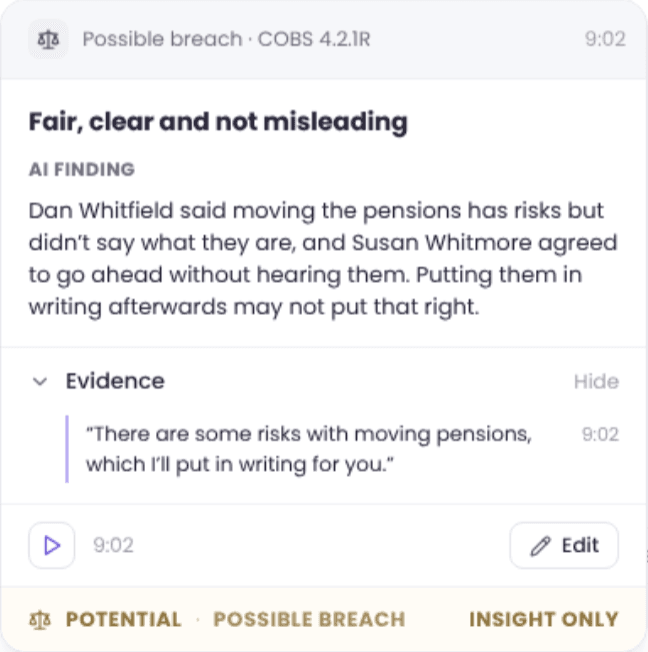
Every judgement must be answerable from the call transcript alone, with a quote from the call as evidence. Your people make the final decision, and when they change a result, the AI's original answer is kept alongside the change.
The instructions the AI follows are versioned, and every review records which version it used. If a verdict is missing or unclear, it goes to a person to decide, and the call's score still publishes with a clear notice. A failed review is kept as its own record, never written over.
That way, any number on any screen can be explained a year later.
Sources
- FCA: Building the future of finance in the age of AI (Jessica Rusu) — 19 October 2026
- FCA: Rethinking regulation for the age of AI (Nikhil Rathi) — 24 June 2026
- FCA: Outcomes monitoring: good practice and areas for improvement — 27 July 2026
- FCA: Multi-firm review into off-channel communications — 7 August 2025
This article is general information, not compliance advice. · Last checked 22 October 2026

Written by the team that builds Converc, drawing on work with compliance, QA and training leads across regulated UK firms.